
Homemade Apple Cider Vinegar
This post may contain affiliate links which won’t change your price but will share some commission.
You won’t believe how easy it is to make homemade apple cider vinegar from scratch. It costs less than a penny per tablespoon!

Apple cider vinegar is a staple in my kitchen. It’s perfect for a quick salad dressing, but it has many other uses as well. I add it to my cranberry walnut chicken salad for extra flavor, and it’s a central ingredient in my homemade barbecue sauce. It gives pulled pork the perfect amount of zing.
You can buy apple cider vinegar, but it’s also easy to make from scratch. It costs next to nothing since apple scraps are typically discarded when making apple crisp, applesauce, or other apple treats. If you can make a spot for the jar on your counter, you can make this recipe.

The cost of store-bought apple cider vinegar varies, but this version is much less expensive than any bottled ACV you can buy. My Target sells Braggs apple cider vinegar for $5.79 for a 32 ounce bottle. This comes out to $1.45 per cup. My homemade apple cider vinegar costs $.02 per cup if you discount the cost of the apple scraps, which were probably heading into the trash after you made an apple treat.
How to Make Apple Cider Vinegar
To make your own apple cider vinegar, submerge apple scraps in water and mix in a little sugar. Use a jar that becomes more narrow at the top so that the apple scraps stay submerged. Cover the jar with butter muslin, a paper towel, or a coffee filter to keep fruit flies away. The mixture will sit at room temperature for a couple weeks to get the process started.


After a few weeks, the scraps get strained out and the vinegar sits at room temperature for at least another month. Eventually, it will begin to taste like a mild version of the ACV you can buy at the store.
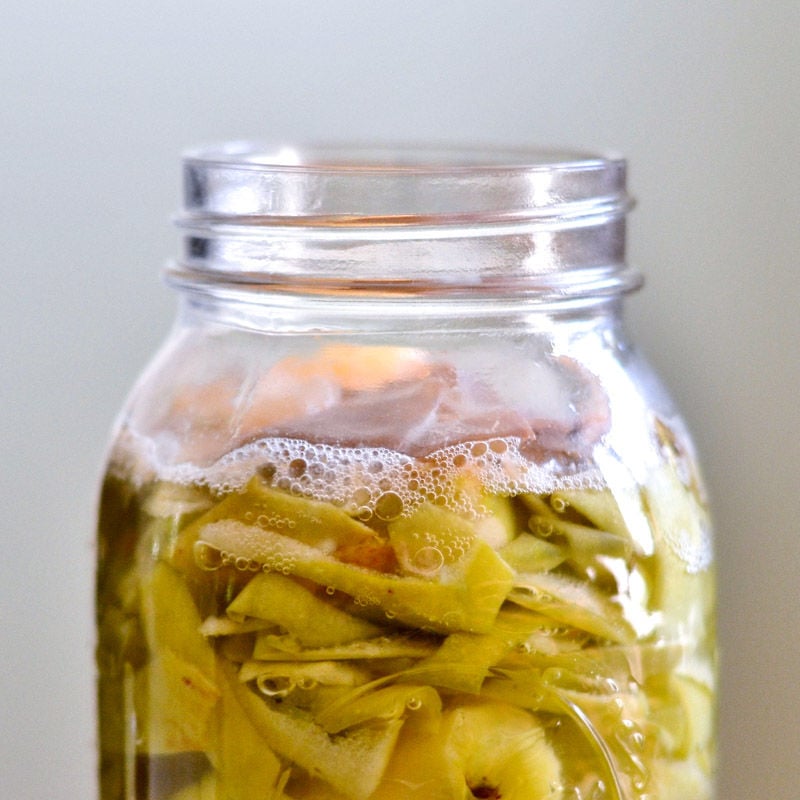
Once it’s finished fermenting, store the vinegar in an airtight container at room temperature. It should keep indefinitely, but the quality may begin to deteriorate after 6 months to a year.
Can You Use Apple Cider Vinegar to Clean?
Apple cider vinegar is an excellent frugal household cleaner. I put 3 parts water and 1 part homemade apple cider vinegar in a spray bottle and use it as a window cleaner.

Equal parts ACV and water can be used for a stronger cleaner on floors, sinks, and other household surfaces. It can even be used to clean up pet messes in the home.
If your batch of DIY apple cider vinegar gets moldy or doesn’t taste how you want it, shift it into a frugal cleaning supply.
Benefits of Apple Cider Vinegar and Honey
For centuries, people have been consuming apple cider vinegar due to several perceived health benefits. Many people like to mix it with raw honey and water to make it more palatable, and to take advantage of the additional benefits of raw honey.
Some studies suggest that these ingredients may help with inflammation, allergies, and weight loss. While these claims haven’t been definitely proven, anecdotal evidence suggests that apple cider vinegar may be beneficial in a wide variety of ways.
Some people swear by apple cider vinegar as a digestive aid, a skin care product, and a hair conditioner. Even if you want to stick to using it just for salad dressing or cleaning, making your own ACV is a simple way to be frugal and avoid food waste.
Homemade Apple Cider Vinegar

Recommended Equipment
Ingredients
- Cores and peels from 6 to 8 apples ideally organic
- 2 tbs sugar
- Water to cover
Instructions
- After you use the apples to make an apple treat, place the cores and peels in a large jar. I use a 4-cup mason jar, but you can adjust the size of the jar according to the amount of apple scraps you're using.
- Cover the scraps with water and stir in the sugar.
- Place a paper towel or a piece of butter muslin on top of the jar, and secure it with a band. (A coffee filter would work as well.)
- Let the mixture soak for 2 weeks at room temperature (I use the back of a cabinet shelf), and then strain out the liquid. Discard the solids, which can be composted at this point.
- Return the liquid to the jar and cover it again with a paper towel or butter muslin and band. Leave it for 4 more weeks, stirring daily.
- Taste the vinegar and see if it has the acidity you would like. If it does, transfer it to a covered bottle for storage. If not, leave it in the large jar for a little while longer, checking every few days. (You can use it as a household cleaner if the flavor doesn't come out how you wanted it.)
- I like to store this vinegar in the refrigerator. It isn't suitable for canning since this homemade version using apple scraps doesn't have the same pH as store-bought apple cider vinegar.
Approximate Nutrition Info
This recipe may contain affiliate links. A purchase or click through one of these links may result in a commission paid to us at no additional cost to you.
Price Breakdown
I don’t assign a price to water in my recipes, and since apple scraps are usually discarded, the only expense in this recipe is the sugar. The full batch costs just $.06 to make, or $.02 per cup. That’s less than a penny per tablespoon. Try this frugal recipe the next time you make a treat with apples.
Pin it here:


Check out my homemade coconut milk for another great affordable DIY recipe!
Note: This recipe was originally published in 2012, and it was updated in 2020.


Hi, while making ACV,how do I keep the MOTHER in ACV asi don’t want to discard it.
Afshan, you can leave the mother in the bottle or add it to a new bottle of vinegar to speed up the process.
why does some recipe called for sugar/honey and others dont? i guess the sweet will help speed up the fermentation? does it matter what kind of apple you have sweet/tart? thank you for the recipe
Cathy, the sweetener is part of the fermentation process. You can use any kind of apple scraps to make cider vinegar. Good luck!
During apple season I will have a lot of peels and cores. What do you think about canning the vinegar?
Paula, I haven’t canned apple cider vinegar in the past, but you can do it. See this article for information about canning temperature: http://ohioline.osu.edu/hyg-fact/5000/pdf/5346.pdf. Good luck!
Thanks!!!
Just a thought – you wouldn’t need to can ACV because it doesn’t need to be sealed in order to stay good. It really doesn’t have a shelf life. So instead of heating it up and destroying some of the therapeutic properties, just put on an air tight lid and store in a cool, dry place. Just my thoughts 🙂
Hi! I was making some applesauce the other day for my little ones and used the scraps to try your recipe. Two weeks have gone by and I just realized that I had the jar covered with a lid…what’s the verdict? Should I throw it out or continue with the 4 weeks? Thanks for your help!!
Ambri, I recommend continuing with the process and using the vinegar for cleaning instead of eating. Hopefully with apple season around the corner you can try again.
I have a question. You know how when you are rising dough, you have to be careful about mold or mildew in your home? Would these affect this vinegar? I’m asking because we have a stone wall basement, there is some mildew, due to the sump hole and the run off from the A/C…and occasional run off from extreme rain. If I were to make this vinegar, I would want to do so in the basement, as my kitchen is entirely too small for anything like this. And I would hate for it to go bad.
It may be okay in your basement, but I’m not sure. To play it safe, I would avoid the basement and find a spot in a closet, behind a chair, or somewhere else in your main living space.
I’m in the process of making thid but i have more of a greenish mold on top, is this normal?
Sharon, you can try spooning the mold off every couple days. If the final product doesn’t seem right, you can use it as a household cleaner.
I just did a Bing search about the mold and it brought me here. Thank you for answering the mold comment. I checked mine after a week and saw bright green mold forming on top and thought I did something wrong. I will spoon it off and let it keep fermenting!!
Thanks for the comment, Shelley! I hope the vinegar comes together well for you.
This is Awesome! I go through a ton of ACV … maybe I’ll start making my own. Thanks 🙂
I recommend it, Nicole. After all the work that goes into peeling a big batch of apples, you might as well get the most of it.
Thanks for sharing. will try this one at home.
Good luck, Antoni! I hope you enjoy it.
On step #4 where you strain out the liquid, do you discard the apple scraps then? Thanks!
Yes, Sonja, you can discard the apple scraps at that point. I put them in our compost.
I use pasteurized honey, but I imagine raw honey would be fine for this as well.
Genius!!! Thanks for sharing 🙂 I too hate to waste, and even though we compost, I like the idea of using it for edible purposes….
thanks for linking up!
After the first two weeks, when the recipe says discard the solids – put them in the compost. Waste not.
Agreed, Susan! The compost is a great place to discard the solids.
I’m so going to try this tomorrow. I was going to dehydrate some apples for snacks so I will have cores and peels ready to go. Thanks for the great idea.
I hope it works well for you, Amy. I would love to have a dehydrator – it’s on my Christmas list!
This will be a fun one to try 🙂
You’ve got nothing to lose. It’s like a free Kindle book!
Can’t wait to try it! Few questions – I have some organic apples that have been in the fridge for like two weeks and are slightly “styrofoamy” in texture now. Do you think it would turn out ok if I used the whole apple if they are a little old? Or I shouldn’t use them because they aren’t as sweet anymore? Also, isn’t apple cinder vinegar usually yellowish? Do they add coloring to it or does the type of apple make it a certain color? Thanks!
Great questions, Catherine! I think the red skin from my apples turns the vinegar pink, so I suppose the commercial cider vinegar either uses yellow skinned apples or leaves out the skin altogether. And as for your aging apples in the fridge, I think it would be fine to use the whole apples.
So I definitely made it and it was going well. Lots of bubbles! Then we had a house showing so I put it in the bottom of a cabinet. I forgot about it and my 15 month old opened the cabinet and spilled it all over the floor! fermenting apples do not smell awesome. Half of the apples were in the jar still so I put some more water in it. There are still bubbles in it, but do you think I need to just restart with fresh apple cores? I can only guess it won’t be as strong.
Oh no! I can imagine that happening in my house too when my kids were little. I would keep it going if it’s still bubbling – what do you have to lose? If it doesn’t seem to get strong enough, it will still be usable as a household cleaner.
cleaner!!! I don’t know why I didn’t think about that too! I’m glad I asked! Thanks!
You’re welcome. Always ask!
Actually, older apples make an excellent base for apple cider vinegar!
And you are correct, that it normally is a dark color, I normally let my apple cider vinegar cure for 2-4 months, the color will be darker by then.
What a clever idea! I usually give the cores to the composting pigs, but they cannot live forever, so I’ll remember this.
Thanks!
My compost loves apple cores, but I’d rather use things in the kitchen when I can! I hope you’ll give this a try.
Will this end up being like brags apple cider vinegar? Brags has the mother of vinegar in it. I wonder can I add some of brags to start then go from there?
I’ve heard great things about Braggs, but I haven’t actually tried it. I don’t see why you couldn’t include some of their vinegar to start.
It probably won’t make any difference adding the braggs because the yeast for the fermentation occurs naturally,the yeast comes from the air,thats why the jar is left open ,same process as home made Ginger beer.
How long will this last bottled and stored in my basement?
It should keep indefinitely, but the quality may begin to deteriorate after 6 months to a year.
I add 1-2 TBSP of Bragg’s Apple Cider Vinegar with the mother and 1-2 TBSPS of sugar to each 1/2 gallon of vinegar that I am making
Also, I allow my apple cider vinegar to sit for about 2-4 months. A “mother” of the vinegar will form over the top and there will be a settlement on the bottom, this is all natural and healthy.
The mother is a clear round object, I would describe it as looking a little bit like a jelly fish!
I’ve been buying Bragg’s for years and it’s up to almost 6 bucks for a small bottle. What IS The Mother? I thought it was the live fermented cultures?
Kate, the mother can look like a little jelled substance floating in the vinegar, but for me it’s just the sediment that sits at the bottom of the bottle. You’re right about what it is – live enzymes and bacteria with health benefits.
Hi Annemarie. I tried it first time and today would be the day to put it in bottles except that there are some tine little worms swimming through the mother. Can’t seem to find anybody mentioning if that is normal or I should throw it out?
I’m not sure, Angela. I haven’t had that happen. I would probably use this batch as a household cleaner and try again unless you can get confirmation from a reliable source that the worms aren’t a problem. Sorry I can’t help more!
What do you do with the mother? And do you strain the last of it before bottling it? Thank you.
I leave the mother in there (when it’s visible), and I don’t do another strain at the end. Good luck!