
Homemade Apple Cider Vinegar
This post may contain affiliate links which won’t change your price but will share some commission.
You won’t believe how easy it is to make homemade apple cider vinegar from scratch. It costs less than a penny per tablespoon!

Apple cider vinegar is a staple in my kitchen. It’s perfect for a quick salad dressing, but it has many other uses as well. I add it to my cranberry walnut chicken salad for extra flavor, and it’s a central ingredient in my homemade barbecue sauce. It gives pulled pork the perfect amount of zing.
You can buy apple cider vinegar, but it’s also easy to make from scratch. It costs next to nothing since apple scraps are typically discarded when making apple crisp, applesauce, or other apple treats. If you can make a spot for the jar on your counter, you can make this recipe.

The cost of store-bought apple cider vinegar varies, but this version is much less expensive than any bottled ACV you can buy. My Target sells Braggs apple cider vinegar for $5.79 for a 32 ounce bottle. This comes out to $1.45 per cup. My homemade apple cider vinegar costs $.02 per cup if you discount the cost of the apple scraps, which were probably heading into the trash after you made an apple treat.
How to Make Apple Cider Vinegar
To make your own apple cider vinegar, submerge apple scraps in water and mix in a little sugar. Use a jar that becomes more narrow at the top so that the apple scraps stay submerged. Cover the jar with butter muslin, a paper towel, or a coffee filter to keep fruit flies away. The mixture will sit at room temperature for a couple weeks to get the process started.


After a few weeks, the scraps get strained out and the vinegar sits at room temperature for at least another month. Eventually, it will begin to taste like a mild version of the ACV you can buy at the store.
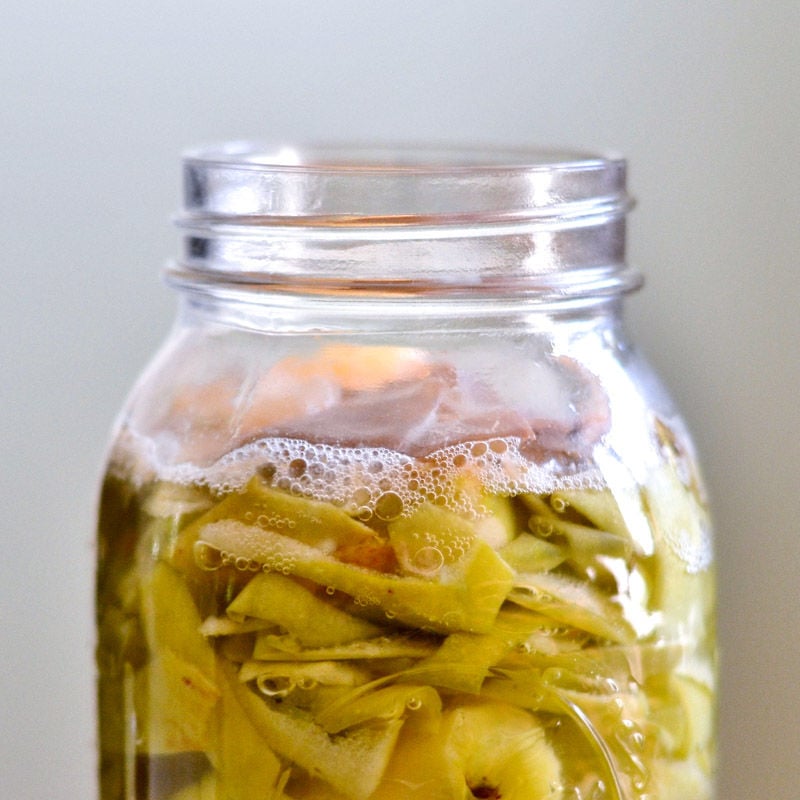
Once it’s finished fermenting, store the vinegar in an airtight container at room temperature. It should keep indefinitely, but the quality may begin to deteriorate after 6 months to a year.
Can You Use Apple Cider Vinegar to Clean?
Apple cider vinegar is an excellent frugal household cleaner. I put 3 parts water and 1 part homemade apple cider vinegar in a spray bottle and use it as a window cleaner.

Equal parts ACV and water can be used for a stronger cleaner on floors, sinks, and other household surfaces. It can even be used to clean up pet messes in the home.
If your batch of DIY apple cider vinegar gets moldy or doesn’t taste how you want it, shift it into a frugal cleaning supply.
Benefits of Apple Cider Vinegar and Honey
For centuries, people have been consuming apple cider vinegar due to several perceived health benefits. Many people like to mix it with raw honey and water to make it more palatable, and to take advantage of the additional benefits of raw honey.
Some studies suggest that these ingredients may help with inflammation, allergies, and weight loss. While these claims haven’t been definitely proven, anecdotal evidence suggests that apple cider vinegar may be beneficial in a wide variety of ways.
Some people swear by apple cider vinegar as a digestive aid, a skin care product, and a hair conditioner. Even if you want to stick to using it just for salad dressing or cleaning, making your own ACV is a simple way to be frugal and avoid food waste.
Homemade Apple Cider Vinegar

Recommended Equipment
Ingredients
- Cores and peels from 6 to 8 apples ideally organic
- 2 tbs sugar
- Water to cover
Instructions
- After you use the apples to make an apple treat, place the cores and peels in a large jar. I use a 4-cup mason jar, but you can adjust the size of the jar according to the amount of apple scraps you're using.
- Cover the scraps with water and stir in the sugar.
- Place a paper towel or a piece of butter muslin on top of the jar, and secure it with a band. (A coffee filter would work as well.)
- Let the mixture soak for 2 weeks at room temperature (I use the back of a cabinet shelf), and then strain out the liquid. Discard the solids, which can be composted at this point.
- Return the liquid to the jar and cover it again with a paper towel or butter muslin and band. Leave it for 4 more weeks, stirring daily.
- Taste the vinegar and see if it has the acidity you would like. If it does, transfer it to a covered bottle for storage. If not, leave it in the large jar for a little while longer, checking every few days. (You can use it as a household cleaner if the flavor doesn't come out how you wanted it.)
- I like to store this vinegar in the refrigerator. It isn't suitable for canning since this homemade version using apple scraps doesn't have the same pH as store-bought apple cider vinegar.
Approximate Nutrition Info
This recipe may contain affiliate links. A purchase or click through one of these links may result in a commission paid to us at no additional cost to you.
Price Breakdown
I don’t assign a price to water in my recipes, and since apple scraps are usually discarded, the only expense in this recipe is the sugar. The full batch costs just $.06 to make, or $.02 per cup. That’s less than a penny per tablespoon. Try this frugal recipe the next time you make a treat with apples.
Pin it here:


Check out my homemade coconut milk for another great affordable DIY recipe!
Note: This recipe was originally published in 2012, and it was updated in 2020.


Hi! I’m here because I googled mold growth while making ACV. The recipe I originally followed didn’t call for any sweetener (just apple scraps and water) and told me to put it away for 6 weeks (it’s only been 2) and then discard solids. My question now is, should I remove the mold, add the sweetener (honey) and let it continue to ferment? Thank you for your help!
That sounds like a good plan, Keelia. Just skim off the mold – it shouldn’t be a problem. If you’re not sure about the quality of the vinegar when it’s done fermenting, you can always use it as a household cleaner. 🙂
Hi
I have made my very first ACV 5 days ago and found my jars need more water so can i add more water in this phase? And how can i concentrate the vinegar?
why does the green mold appear?
Cheers!
Yes, you can definitely add more water as needed. The vinegar will get more concentrated over time. If you’re concerned about the mold, you can use this as a household cleaner.
Hi, I tried making some ACV at home and it seems there is like a red thick layer of mother floating on top with a little moss like appearance on it. It’s been resting in the cupboard for 3 weeks now and I haven’t been mixing it everyday. Just letting it sit there. Can you please explain why the red colour ? Do I need to throw this batch ? Many thanks !
I’m not sure about the red color. It may be related to the type of apples you used. If you’re in doubt about consuming the vinegar, I recommend using it as a household cleaner. It does wonders!
Great post Annemarie! Made my own using half a cup braggs, apple peels, and no sugar in a half gallon mason jar with the cheesecloth lid. A note on that is to definately fold the cheesecloth over several thicknesses, so it can still breathe but is well protected. It smells fabulous, like a wonderful fresh apple treat, but tastes almost alchohol-like. So I removed the peels and put another half cup braggs and quarter cup white sugar. It has been going for a month and a half. The mother was nice round and white at last check, but I lost about half of it when I messed with the batch. My plan is to use this as my “Mother” batch… (thas punny)… and just keep it going. Thanks for all the extra info! 😉
Fantastic! Sounds like it’s coming along well. It’s great to have a mother batch to work with. Thanks for the feedback.
I started out to make a pear wine, but for the first time ever, it went vinegary before I even added the yeast and sugar. When I realized it was vinegary, I still added the yeast and sugar, thinking that I could save it. Not! It has a slight film of dead yeast cultures floating, but no mould and it smells yummy, albeit vinegary. Can I just strain this and use it as a vinegar?
Jeff, it may work as vinegar, but I can’t say for sure. It’s worth a try, and you can always use it as a cleaner if it doesn’t taste right. 🙂
So this doesn’t spoil?
Rachelle, vinegar keeps for a long time in a cool cabinet.
Hello i was hoping for some help in making my first apple cider vinegar. The scoop is that I managed to have some mother form from my attempt last month of making pear vinegar (very exciting). Now I have a large bottle of sweet apple cider picked up from a farm last month. The bottle says it’s pasturized sweet apple cider and I read that it has no preservatives or the like and no sugars added. My question is does it matter that it’s pasturized since I can put the mother that I already have? Also I had tried to make some peach vinegar I left it seating for about 2 months. There was a slight jelly looking thing floating but nothing like my pear mother. At about 3 to 4 weeks it had a slight vinegary taste however when I tasted it tonight it was watery. What did I do wrong?
Dawn, I’ve never tried peach or pear vinegar before, so I’m not sure what went wrong. I don’t actually use apple cider to make my vinegar, just apple scraps. Good luck!
Thank you Annemarie for the reply. My pear vinegar turned out awesome you should try it. ( A friend of mine gave me some pears from her tree and just like apples I used the scraps) Also I made some cherry vinegar and it looks like it’s going some where, just saw that the mother is forming. We will see if the sweet apple cider does’t work than luckily it’s apple season!!!! By the way thank you for all the info and the pictures help a lot.
Thanks, Dawn. The pear vinegar and cherry vinegar sound amazing. I need to find a friend with a pear tree!
I want to try this in a 5 gallon pail with wild apples that grow along the snake river here in Idaho. Have you any idea of the weight of honey/sugar to apple?
Did you get a dehydrator yet? If not make sure you get one of quality. I got an “Excalibur” and it is the most awesome thing in my kitchen besides my sourdough starter.
Forrest, I think about a tablespoon of honey/sugar to a pound of apples will work. And I did just recently get a 5-tray Excalibur. It’s a great machine.
NICE! Thanks for the reply. Im starting my ACV now. Will a burp valve work in place of a towel or does it need wild yeast to ferment? ( like sourdough starter)
Also if you make jerky try Worcestershire sauce and bbq sauce marinade (5 to 1) with a few pureed fresh jalapenos. Best jerky ever. ( smart and final has gallons of lee and perrins Worcester sauce for about 10$)
Thanks again.
I haven’t tried this with a burp valve, so I’m not sure. Good luck!
Thanks so much. I can get Brags but so expensive. I am allergic to corn, but do use white vinegar to clean almost everything. Been thinking lately this may not be so wise, especially seeing as its GMO also. My kids never finish their apples even when cut up, I can’t help because yes I am also allergic to uncooked apples. Thinking of trying this at least not GMO, its basically free, and I might not have a problem with it because the fermentation might kill the enzymes I am allergic to just like cooking does(Q10 effect). I guess I can research that while waiting for it to get done.
What is MOTHER and what are its benefits? I’m in the process of making your ACV as well. Is that the clear pink slimy stuff? I’ve been skimming it out. Should I leave it in there?
Some people describe the mother as a jellyfish-like texture, so that’s probably what you’ve been skimming off. You can leave it in there for added benefits. When I make ACV I don’t get a slimy mother, but just some sediment at the bottom. It may be due to the fact that my house is cold. 🙂
I can’t get the Braggs acv here where I live but they do have organic apples. I will be trying this, thanks.
Good luck, Doris! I hope the recipe works well for you.
I started my ACV experiment a week ago using no sweetener – just scraps and water. It is bubbling and looking ok so far. Should I add honey at this point? Can I use the mother as a SCOBY for other purposes?
Eileen, I’ve never made apple cider vinegar without adding honey or sugar. I believe the sugar is an essential part of the fermentation process.
I made my first batch last fall with just apples and water, no sweetener, and it came out awesome! I left it ferment for three months, scooped out the apples and put them in baggies for my friend ‘s chickens, they love it she said. Just about to make my second batch; making a 5 gallon bucket or more this year because I used my two gallons up from last fall.
If I wanted to use the Apple Cider for cleaning what can it be used for?
Julie, you can mix it with water to clean floors, sinks, etc. I put 3 parts water and 1 part vinegar in a spray bottle and use it as a window cleaner. You can do a search online to find other cleaning recipes for ACV.
equal parts ACV and water work great for cleaning up pet accidents! I’ve tried those really expensive “miracle” enzymes and they work so so…this works so much better! On carpet you really saturate it…..let it sit 10 minutes, then soak as much as you can up with an old towel and run a fan over it to let it dry. The towel washes easily and does NOT smell like vinegar or pee. The floor smells lightly of vinegar for a day or so but when it dries it doesn’t smell like anything to humans, but dogs and cats still smell it so they won’t go there again!
When you say acv mother, is that like a Scoby? If so, would using a Scoby in mine be useful? I happen to have a few right now from making kambucha
Yes, Ramona, I believe SCOBY and the acv mother are synonymous.
I would love your help…I began two differing containers (first one smaller, aged the peels and cores a day and then water, sugar…covered w/cheesecloth, put jar away; 2nd began several days later, forgot to ‘brown’ for a day or so the peels and cores. Water, honey..covered w/cheesecloth.
Now just over a week later, 1st batch…I just ‘peeked’ at the jar, cheesecloth ‘brown’ w/fluid? Pulled it out of its hidey hole to discover tiny holes in cheesecloth, two fruit flies on cheesecloth…pulled off rubber banded cheesecloth to discover larva! Dumped all, scrubbed jar…
2nd jar…fruit have floated above water line…fuzzy mold on fruit…do I discard entire jar? Or as suggested above, ‘pull out fuzzy covered fruit’, recover and let’r go…?
How to I push the fruit and keep it down w/out plastic, metal, etc. in touch w/fruit and liquid…or not a concern?
thank you so much..
Michaele, I think it will be fine if you remove the moldy fruit and keep it going. I don’t push the fruit down, but I do cover with a paper towel rather than cheesecloth. I’m wondering if the holes in the cheesecloth may be causing these issues. I recommend continuing the process with jar #2, and if it doesn’t taste right at the end you can use it as a household cleaner. Good luck, and let me know how it turns out!
Hi,
Thank you very much for the recipe as well as taking the time to answer all our questions! Much appreciated.
Due to my own stupidity I forgot to stir the mixture at the end of the first week of the second phase for 3 days!(after straining and at the end of the first week in to the 4 weeks phase). Can I still use it as vinegar or has its fate been determined as cleaning solution?
It should still be fine, Lili. I don’t think it will be a problem, but use your judgment if the final product seems funky.