
Homemade Apple Cider Vinegar
This post may contain affiliate links which won’t change your price but will share some commission.
You won’t believe how easy it is to make homemade apple cider vinegar from scratch. It costs less than a penny per tablespoon!

Apple cider vinegar is a staple in my kitchen. It’s perfect for a quick salad dressing, but it has many other uses as well. I add it to my cranberry walnut chicken salad for extra flavor, and it’s a central ingredient in my homemade barbecue sauce. It gives pulled pork the perfect amount of zing.
You can buy apple cider vinegar, but it’s also easy to make from scratch. It costs next to nothing since apple scraps are typically discarded when making apple crisp, applesauce, or other apple treats. If you can make a spot for the jar on your counter, you can make this recipe.

The cost of store-bought apple cider vinegar varies, but this version is much less expensive than any bottled ACV you can buy. My Target sells Braggs apple cider vinegar for $5.79 for a 32 ounce bottle. This comes out to $1.45 per cup. My homemade apple cider vinegar costs $.02 per cup if you discount the cost of the apple scraps, which were probably heading into the trash after you made an apple treat.
How to Make Apple Cider Vinegar
To make your own apple cider vinegar, submerge apple scraps in water and mix in a little sugar. Use a jar that becomes more narrow at the top so that the apple scraps stay submerged. Cover the jar with butter muslin, a paper towel, or a coffee filter to keep fruit flies away. The mixture will sit at room temperature for a couple weeks to get the process started.


After a few weeks, the scraps get strained out and the vinegar sits at room temperature for at least another month. Eventually, it will begin to taste like a mild version of the ACV you can buy at the store.
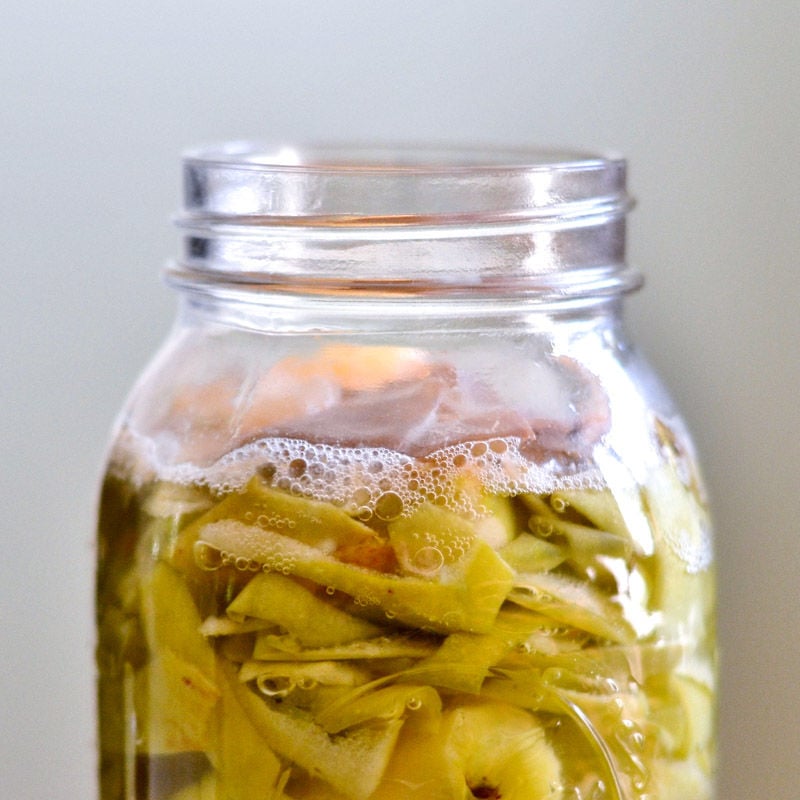
Once it’s finished fermenting, store the vinegar in an airtight container at room temperature. It should keep indefinitely, but the quality may begin to deteriorate after 6 months to a year.
Can You Use Apple Cider Vinegar to Clean?
Apple cider vinegar is an excellent frugal household cleaner. I put 3 parts water and 1 part homemade apple cider vinegar in a spray bottle and use it as a window cleaner.

Equal parts ACV and water can be used for a stronger cleaner on floors, sinks, and other household surfaces. It can even be used to clean up pet messes in the home.
If your batch of DIY apple cider vinegar gets moldy or doesn’t taste how you want it, shift it into a frugal cleaning supply.
Benefits of Apple Cider Vinegar and Honey
For centuries, people have been consuming apple cider vinegar due to several perceived health benefits. Many people like to mix it with raw honey and water to make it more palatable, and to take advantage of the additional benefits of raw honey.
Some studies suggest that these ingredients may help with inflammation, allergies, and weight loss. While these claims haven’t been definitely proven, anecdotal evidence suggests that apple cider vinegar may be beneficial in a wide variety of ways.
Some people swear by apple cider vinegar as a digestive aid, a skin care product, and a hair conditioner. Even if you want to stick to using it just for salad dressing or cleaning, making your own ACV is a simple way to be frugal and avoid food waste.
Homemade Apple Cider Vinegar

Recommended Equipment
Ingredients
- Cores and peels from 6 to 8 apples ideally organic
- 2 tbs sugar
- Water to cover
Instructions
- After you use the apples to make an apple treat, place the cores and peels in a large jar. I use a 4-cup mason jar, but you can adjust the size of the jar according to the amount of apple scraps you're using.
- Cover the scraps with water and stir in the sugar.
- Place a paper towel or a piece of butter muslin on top of the jar, and secure it with a band. (A coffee filter would work as well.)
- Let the mixture soak for 2 weeks at room temperature (I use the back of a cabinet shelf), and then strain out the liquid. Discard the solids, which can be composted at this point.
- Return the liquid to the jar and cover it again with a paper towel or butter muslin and band. Leave it for 4 more weeks, stirring daily.
- Taste the vinegar and see if it has the acidity you would like. If it does, transfer it to a covered bottle for storage. If not, leave it in the large jar for a little while longer, checking every few days. (You can use it as a household cleaner if the flavor doesn't come out how you wanted it.)
- I like to store this vinegar in the refrigerator. It isn't suitable for canning since this homemade version using apple scraps doesn't have the same pH as store-bought apple cider vinegar.
Approximate Nutrition Info
This recipe may contain affiliate links. A purchase or click through one of these links may result in a commission paid to us at no additional cost to you.
Price Breakdown
I don’t assign a price to water in my recipes, and since apple scraps are usually discarded, the only expense in this recipe is the sugar. The full batch costs just $.06 to make, or $.02 per cup. That’s less than a penny per tablespoon. Try this frugal recipe the next time you make a treat with apples.
Pin it here:


Check out my homemade coconut milk for another great affordable DIY recipe!
Note: This recipe was originally published in 2012, and it was updated in 2020.


I’m on my second fermentation but I split the batch into 2 separate jars. One looks normal and is starting to smell like ACV. The other is turning pink and smelling sweeter. Is this second batch awry?
Stephanie, I haven’t had that experience with splitting a batch, so I’m not sure. You could give it more time and see if it starts to smell like vinegar. I have had colors ranging from pink to brown depending on the color of the apple skin.
After the first 2 week Fermentation there was some fuzzy white greyish mould growing on top of the liquid, I scooped it off and strained the liquid for 2nd ferment but is it still safe to use? Try to read all the replies here but got confused as mould is usually a sign of spoilage and makes the product unsafe to eat.
If you’re concerned, you can use it as a cleaner.
I’m going to try this with my kids, as soon as we get moved. Now I’ve got to get my hands on a narrow mouth canning jar
I am trying this bit today when I went to discard the apple scraps some on the top were moldy. Just wondering what I did wrong? Not enough water covering. Any help wold be appreciated. Thanks.
Jenny, you can avoid the mold by using a jar that gets narrower at the top. This will help keep the apple scraps submerged. Your vinegar should still be okay, but if you’re not sure, you can always use it as a household cleaner.
Once the apple cider vinegar is made how long is this good for?
Also can I keep the jar in my cabinet like store bought vinegar?
Thanks!
Gina
Gina, you can store this vinegar in an airtight container at room temperature. It should keep indefinitely, but the quality may deteriorate after several months or a year.
Hi, what about gnats? Theyve gotten past my cheesecloth and into it…
Meghan, I’m guessing it would be fine after you strained out the gnats, but to be on the safe side, you could use this batch as a household cleaner. I use a paper towel or tighter butter muslin (rather than cheesecloth), so I haven’t had fruit flies get into my vinegar.
Who knew this was so easy? Definitely featuring in a future Healthy Kitchen Hacks post!
This is so cool!!! I love finding a higher purpose for our scraps too 🙂 I’ve just gotten into making kombucha…I think this is the next experiment I need to conjure up!
I cannot wait to make this! I use cider vinegar daily,, and would love to have homemade
Great post! Does anyone have a suggestion for replacing paper towel? I see some have tried cheese cloth but had issues. Would a towel work?
Jen, a thin towel or butter muslin should also work.
Thank you Annemarie!
coffee filter?
A coffee filter would work.
I like to use paper coffee filters
I am using a coffee filter to cover mine. We’ll see how well that works.
Hi, I am wondering if I could use red wing crocks for this instead of a glass jar? I have a 1 and 2 gallon I would like to use.
I’ve never tried this in a crock, Teresa, but I don’t think it would be a problem.
Hi there. Fantastic Blog, many thanks. Did I read that you can use a Scoby from Kombucha Tea to make ACV? If so can you use the Mother from ACV to make Kombucha?
My ACV with the Mother in it looks like spider webbs or maybe cloudy is a better description. I want to make my own ACV and I will use the left over sediment from the bought ACV which is the Mother. I make a lot of Bone Broth and ACV is part of the recipe.
Regards
Frances from Sunny South Africa
Frances, you can make your own ACV using the sediment from store-bought vinegar. I’m not sure of the relationship to kombucha, though. Let me know if you experiment with it.
I never considered making my own apple cider vinegar…I don’t know why, because we go through it like crazy here. This is really great to know, thank you!
Once I took out the apples and am on now a week later and noticing what looks like layer of mold on top of the liquid. What did I do wrong?
Were the apples fully submerged in the liquid? If not, that can cause mold on top.
Hi Annemarie, I have been looking for a recipe for this type of cider. My husband started making the “Dr. Axe Detox” which uses a lot of apple cider vinegar and he drinks it 2 times per day. Pinned!
I’ve had issues with my jars overflowing. I’m only on my 4th/5th day. I’ve just been pushing the peels down and recovering, and today I took out some of the extra liquid. So I’ve got a few questions:
Do you know what would cause the overflow? Did I just add too much water initially?
Will it be ok that some of the peels aren’t fully submerged now?
Is it ok that I disturbed it or should it sit as still as possible?
Is it better for it to sit in a light or dark place?
Does temperature affect it any?
Mary, I haven’t had the experience of jars flowing over, so I’m not sure what caused that for you. It’s okay to leave it how it is at this point. I recommend keeping the jar in a dark place at room temperature. Good luck!
The overflowing is part of the fermentation process, I have the same problem making sauerkraut. You can use a knife or other long utensil to move the peels around and let the bubbles up so they don’t push the water out of the jar. It won’t hurt anything as long as your utensils are clean. It does seem to happen more when it’s warmer in my kitchen. I haven’t made ACV yet. I’ll trying this tomorrow!
When you get to the vinegar point, is it safe to rebottle it into a stoppered bottle and does it have to be stored in the fridge? Oh, and does the mother have to be in the bottle with it?
Robert, an airtight seal is always best for storage, and it can be stored at room temperature. The mother isn’t always visible in homemade vinegar, but you can leave it in if you do see it. (That’s up to you.)
I made the vinegar, but when I checked it the first time, the jar was filled with fruit flies and larva. Did your recipe ever produce fruit flies? It has made me wonder if we eat larva on fresh fruit. Thank you for any response. I am disappointed, but would try it again.
I’m sorry to hear that, Susan. I haven’t had an issue with fruit flies, but that can happen if you use cheesecloth with wide openings. I would strain them out and use it as a household cleaner.
I used VIVA paper towel. Would it have happened with wild apples? Perhaps the ones at the store are cleaner. I would like to try it again. We disposed of them immediately, so they wouldn’t get in the house. Thank you for your prompt reply.
Hey! I just made my first batch but I used sugar and it wasn’t raw will it be okay?!
Yes, it will be fine with sugar, Maddy. Let me know how it goes!